
Ghalia Boustani
PhD · Retail Expert & Author
The phrase 'retail experience' is everywhere. Brands invest in it. Consultants sell it. Magazines celebrate it. And yet, when pressed to define it with precision , to explain what it actually consists of, how it is operationalised, and what it is meant to achieve , the conversation often dissolves into generalities. 'It's about emotion.' 'It's about storytelling.' 'It's about making customers feel something.'
These statements are not wrong. But they are insufficient. The retail experience is a manageable, measurable, and designable construct. It is not magic. It is architecture , of space, time, sensory stimulation, social interaction, and meaning. And like any well-designed system, it can be built with intention, calibrated against objectives, and evaluated against outcomes.
Experience is not a mood. It is a system. And systems can be designed.
Defining the Retail Experience
At its most precise, the retail experience is the sum of all perceptions and responses , cognitive, emotional, sensory, behavioural, and relational , that a consumer has during an interaction with a brand in a physical or blended retail context. It begins before the consumer crosses the threshold (or lands on the digital touchpoint) and continues after they leave.
This definition has several important implications. First, the retail experience is not confined to the store. It encompasses the journey to the store, the anticipation that precedes it, and the memory and narration that follow it. Second, it is not created by any single element. Lighting, product display, staff interaction, scent, sound, waiting time, packaging, and payment process all contribute. The experience is the aggregate , and the coherence , of all of these.
Third, and most importantly for brand strategy: the retail experience is relational, not transactional. A transaction is an exchange of money for goods. An experience is a value exchange that may or may not involve an immediate purchase. A consumer can have a profound retail experience without buying anything , and that experience may be more valuable to the brand than a transactional visit from a low-engagement customer.
The Architecture of Experience: Four Dimensions
1. Sensory Design
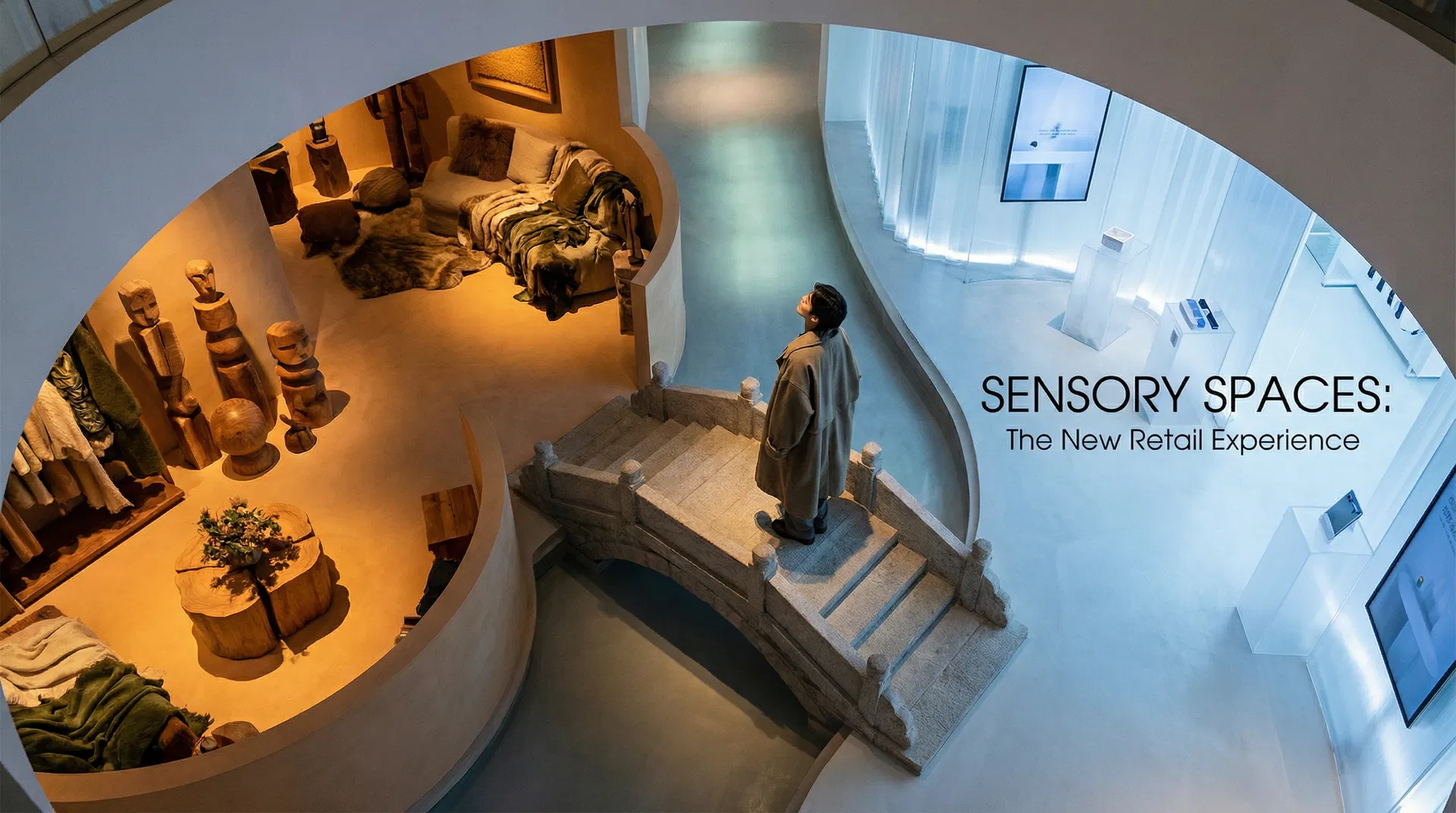
The physical environment communicates before a single word is spoken. Temperature, lighting colour and intensity, sound level and music selection, scent, material textures, spatial proportions , all of these are legible to the consumer's nervous system before their conscious mind engages. Brands that understand this design with all five senses, not just the visual.
Nike's flagship stores deploy sound design calibrated to energise without overwhelming. Aesop's stores are architecturally distinctive , each one different, each one saturated with the brand's characteristic scent. Lush's stores are deliberately chaotic and fragrant, creating an experience that is as much olfactory theatre as retail.
2. Spatial Narrative
How does the space tell a story? Great retail environments have a logic of discovery. The consumer's path through the space is choreographed , not rigidly, but with intention. There are moments of density and moments of breath. There are focal points that draw the eye and invite engagement. There are thresholds that mark transitions between areas with different emotional registers.
Hermès' flagship stores are masterclasses in spatial narrative. Each floor has its own atmosphere, its own product universe, its own emotional tone. The journey through the store is a journey through the world of the brand , its materials, its craftsmanship, its history, its vision of beauty.
3. Human Interaction
The people in the store are not props. They are the most powerful and most volatile element of the retail experience. A single conversation with a knowledgeable, attentive, and warm sales associate can transform a casual visit into a memorable brand encounter. A dismissive glance, an unhelpful answer, or a failure to acknowledge can undo everything that the space and the product have achieved.
This is why experience-led retailers invest disproportionately in staff training , not product knowledge training, but experiential training. Apple Retail's 'Genius Bar' model redefined what retail staff could be: educators, problem-solvers, collaborators rather than salespeople. The role was redesigned. The result was a different kind of interaction.
4. Temporal Design
Time in the store is a dimension that most retailers manage badly. Queues, waiting times, the pace of service, the moment at which a customer is approached , all of these shape the emotional texture of the experience. A twenty-minute wait can feel tolerable or intolerable depending on how it is managed. The same time feels different in different spatial and social contexts.
Luxury hospitality has understood temporal design for decades. The great hotels manage every minute of the guest's arrival , the greeting, the check-in sequence, the escort to the room , as a choreographed composition. Luxury retail at its best applies the same logic.
Managing time is as important as managing space. Customers remember how they felt while they waited.
How It Is Managed
The retail experience does not manage itself. It requires dedicated governance structures, cross-functional ownership, and clear measurement frameworks. In practice, this means three things.
Experience Standards: Articulated, documented, and regularly audited standards for every touchpoint in the customer journey. Not vague aspirations ('be warm and welcoming') but specific, observable behaviours and environmental conditions.
Cross-Functional Ownership: The retail experience is owned by everyone , visual merchandising, operations, HR, marketing, and store management all contribute to it. But someone must hold accountability for its coherence. In leading organisations, this is often a Chief Experience Officer or a dedicated experience design function.
Measurement: Net Promoter Score, customer satisfaction surveys, mystery shopping, dwell time analysis, conversion rate tracking, and , increasingly , qualitative ethnographic research that captures the texture of consumer experience beyond numerical scores.
What It Yields
A well-designed retail experience yields outcomes that extend far beyond immediate sales. The most significant are brand advocacy, increased customer lifetime value, reduced price sensitivity, and emotional loyalty that is resistant to competitive disruption.
The research is consistent on this point. Consumers who rate their in-store experience as exceptional are significantly more likely to recommend the brand, return more frequently, and spend more per visit. They are also less likely to defect to competitors on the basis of price alone. Experience creates switching costs that are not financial. They are emotional.
For brands competing in categories with low product differentiation , where what is sold is relatively similar across competitors , the experience is often the primary differentiator. The consumer is not choosing between two moisturisers. They are choosing between two brands, and the store is where that choice is made or confirmed.
Conclusion
The retail experience is not a soft concept. It is a hard competitive advantage , one that can be designed, managed, and measured with the same rigour applied to supply chain or pricing strategy. Brands that treat it as such will consistently outperform those that treat it as decoration.
The investment required is not trivial. But neither is the return. In an era where product parity is the norm and digital channels commoditise discovery, the physical retail experience remains one of the few remaining spaces where brands can create genuine, irreplaceable value.
, Dr. Ghalia Boustani
— CONTINUE THE CONVERSATION
Want deeper insights like this?
Ask Ghalia's Brain — 20 years of retail expertise, available 24/7 on WhatsApp. Start for free.
ASK GHALIA'S BRAIN