The Pop-Up Paradox: How Luxury Brands Turned Temporary Retail into a Permanent Strategy

Ghalia Boustani
PhD · Retail Expert & Author
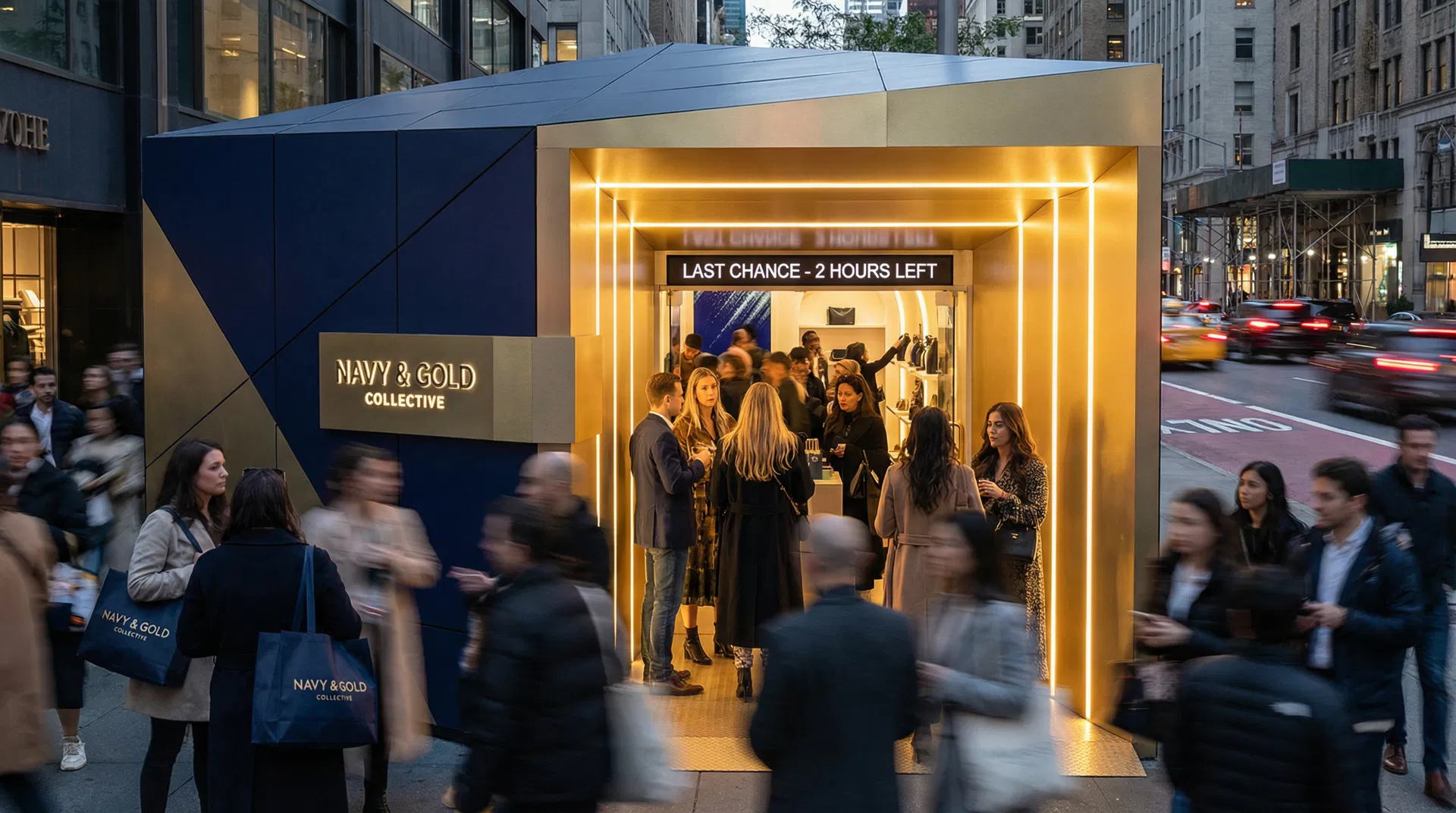
There's a strange contradiction sitting at the heart of luxury marketing today. The entire value proposition of houses like Hermès, Dior, and Gucci rests on scarcity, the idea that not everyone can have it, see it, or touch it. And yet these same brands are now spending fortunes on pop-up stores: structures built specifically to disappear in a matter of weeks.
That contradiction is precisely the point. Pop-ups let luxury brands open the door just wide enough to let the masses peek into the dream, without ever actually lowering the threshold of exclusivity. They've become less a retail format and more a storytelling device, and the way Hermès, Dior, Gucci, and smaller houses like Fauré Le Page are deploying them reveals a deliberate, almost theatrical, channel strategy.
From real estate to narrative device
A decade ago, a pop-up was a tactical tool: a way to test a new city, liquidate stock, or generate short-term buzz before a real lease was signed. Pop-ups were framed as a low-risk, low-commitment way to test a concept, gather performance data, and refine retail strategy, leveraging scarcity to capture attention.
That's no longer the full picture for luxury. Industry observers now describe the most committed pop-up players as executing a deliberate, data-backed retail strategy designed to build brand equity, test markets, and deepen customer relationships, not merely experimenting. The pop-up has shifted from a real estate decision to a narrative one, a stage set built to deliver a chapter of the brand's story that a permanent flagship, with all its institutional weight, can't easily tell.
Hermès: turning craftsmanship into a participatory ritual
Hermès is the clearest case study in pop-up-as-storytelling. In 2017, to mark the 80th anniversary of its silk carré, the house opened Hermèsmatic, a pop-up styled as a retro laundromat, complete with orange washing machines, where visitors could dip-dye their own worn Hermès scarves. Hermès USA's CEO explained the idea was to "surprise" clients by encountering the brand in a totally unexpected location and way, a laundromat. The first iteration ran in New York for less than a week before touring to Los Angeles and other cities, with retro washing machines doubling as Instagram-ready props.
The genius of Hermèsmatic wasn't retail volume. Hermès's immediate goal was clearly not to sell scarves; the most enduring outcome of the pop-up was the user-generated content it produced on Instagram, from both the brand and visitors. It converted a luxury object into a participatory ritual, and turned customers into the brand's own media channel.
Crucially, this worked because it didn't try to explain the myth, just stage a fragment of it. Hermès's more recent New York pop-up, "Mystery at the Grooms," an immersive equestrian-themed whodunit, shows the limits of the same playbook when stretched too far. One review called it an opulent pop-up that promised myth but delivered little more than mass-market theater, even as it acknowledged that every advance slot was booked and Instagram reels of the experience went viral. The piece argued that in trying to make its rarefied world more democratic, Hermès let people who may never own a Birkin brush shoulders with the brand's dreamscape, popular success, but a reminder that over-explaining the fantasy is its own risk.
Dior: resort pop-ups as geographic storytelling
Dior has used pop-ups primarily as a way to extend its narrative geographically, placing the maison's universe in places its flagships physically cannot reach. The house has launched multiple international pop-up stores, including in Italy and Mexico, to showcase capsule collections in immersive and exclusive settings. Dior has also taken its seasonal collections directly to luxury beach resorts such as Mykonos and St. Tropez, alongside F1 race weekends and yacht shows offering private shopping lounges for ultra-high-net-worth clients.
This is a different storytelling mechanic than Hermès's participatory approach: Dior is less interested in turning customers into content creators and more interested in following its own clientele's seasonal migration, Capri in summer, Aspen in winter, so the brand narrative travels with the lifestyle it's selling, rather than asking the customer to travel to it.
Gucci: the pop-up as a technology showcase
Gucci has leaned into pop-ups as proof of the brand's modernity, treating temporary retail almost like a product demo. The brand's traveling container store blends luxury and technology, integrating solar panels, AI-powered product recommendations, and digital styling assistants. Its Gucci Pin concept extended this further: a global network of interactive pop-ups leveraging augmented reality and social sharing.
Where Hermès uses craft and nostalgia, Gucci uses spectacle and technology, but the underlying mechanic is identical: give people something they can photograph, share, and credit to the brand, converting a temporary physical footprint into a much larger and more durable digital one.
Fauré Le Page: heritage in small, intimate doses
Fauré Le Page operates at a different scale than the LVMH or Kering giants, but its pop-up logic mirrors theirs in miniature. Founded in 1717 as an arms maker to the French monarchy, the maison built its modern identity around finely crafted leather goods carrying its scale motif, blending centuries-old heritage with bold modernity. Without the marketing budgets of Dior or Gucci, Fauré Le Page relies on selective retail partnerships and pop-up activations (such as its placement within department-store environments like Printemps) to introduce its heritage story to audiences who might never have encountered a smaller French maison otherwise.
This illustrates an important point for the broader category: pop-ups aren't just a tool for giants flexing budget. For a house with limited flagship presence, a well-placed temporary activation can do the introduction work that decades of advertising would otherwise need to accomplish.
The illusion of relationship: bridging luxury and the masses
What ties all of these examples together is a single mechanic: pop-ups manufacture proximity without conceding access. A flagship boutique on Avenue Montaigne signals permanence, hierarchy, and distance, you're visiting the brand's house, on its terms. A pop-up inverts that. It shows up in a laundromat, a beach resort, a shipping container, a department store atrium, spaces coded as ordinary, transient, or at least more reachable than a marble-floored maison.
As one industry analysis put it, the fleeting presence of pop-ups stokes curiosity for what may be a whirlwind romance or the beginning of an enduring relationship. That's the illusion at work: the pop-up offers the feeling of an intimate, momentary relationship with a house that, in its permanent form, holds the public at arm's length. Visitors leave believing they've had a personal encounter with the brand, even if what they actually experienced was a meticulously engineered stage set, open for ten days and gone.
This is also why pop-ups have become inseparable from social content. A visually engaging pop-up encourages visitors to take photos, share content, and promote the brand organically, with influencer marketing being particularly effective when combined with experiential retail and exclusive access. The pop-up isn't just a room; it's a backdrop engineered for a phone camera, designed to generate its own distribution.
Why this matters strategically
Three forces are pushing luxury brands toward pop-ups as a near-permanent fixture of their channel mix rather than an occasional stunt.
Brand storytelling has outpaced what a flagship can deliver. A permanent store has to serve every part of the catalogue, every season, every customer segment. A pop-up can tell one story, fully, for a finite window, Hermès's scarf heritage, Dior's resort lifestyle, Gucci's technological ambition, without diluting it with everything else the house also sells.
Data and risk are now explicit objectives, not side effects. Pop-up stores reduce financial risk substantially, with less commitment to lease, sales staff, and furniture, while still letting brands understand and engage their customer base before deeper investment. That risk-reduction logic, originally built for digital-native upstarts entering physical retail, has been absorbed wholesale by maisons centuries older than the concept of e-commerce.
Geography matters differently now. Industry analysis of the luxury sector notes that growth is increasingly fuelled by the Middle East, Asia, and India, where consumers expect culturally significant craftsmanship blended with global modernity, and brands that adapt their narratives to these audiences are best positioned for long-term loyalty. Pop-ups are the fastest, lowest-risk way to test and adapt a narrative market by market, before a flagship lease is ever signed.
The line between marketing spend and retail spend has blurred. Hermès's scarf-dyeing pop-up was never meant to move meaningful units; its return was earned media and brand affinity. This fits the house's broader posture of favoring craftsmanship-led storytelling and flagship events over traditional advertising, keeping marketing spend near 5 to 6 percent of revenue versus a luxury-sector average closer to 10 to 12 percent. A pop-up amortizes as both a retail line item and a content-production budget, which is part of why it has become so efficient relative to traditional campaigns.
Managerial implications
For brand and retail leaders watching this trend, a few practical takeaways stand out.
Treat the pop-up brief as a narrative brief, not a real-estate brief. The first question shouldn't be "where's available retail space," but "what single fragment of our brand story do we want this audience to experience, and what makes it shareable." Hermès didn't ask "where can we sell scarves," it asked "what unexpected ritual makes our heritage feel alive."
Calibrate the gap between fantasy and explanation carefully. The "Mystery at the Grooms" case is instructive precisely because it succeeded by conventional retail metrics (full bookings, viral content) while drawing criticism for over-explaining the brand's mystique. Managers should treat that as a real trade-off: popularity and dilution can rise together, and a pop-up's job is to gesture at the brand world, not narrate it in full.
Build measurement frameworks beyond sales and footfall. Effective pop-up evaluation increasingly tracks NPS, social engagement, and web traffic uplift alongside on-site revenue, because, as the Hermèsmatic case shows, the commercial return is often indirect and delayed, realized through earned media and renewed customer affinity rather than point-of-sale revenue.
Use scale-appropriate versions of the same mechanic. A house with Hermès's or Gucci's budget can build a custom container store with AI styling assistants. A house at Fauré Le Page's scale can achieve a similar narrative effect through a well-chosen department-store activation or limited retail partnership, the storytelling logic scales down even when the production budget doesn't.
Sequence pop-ups deliberately across markets, not just calendar dates. With growth increasingly concentrated outside the brand's home market, pop-ups are becoming a market-entry and narrative-adaptation tool, a way to test how a house's story translates to a new region's cultural expectations before committing capital to a permanent footprint there.
The pop-up has become a paradox luxury brands have learned to use to their advantage: a structure built to vanish, used precisely because permanence would undercut the dream it's selling. The masses get the encounter; the brand keeps the mystery intact for the next time the doors close.
— CONTINUE THE CONVERSATION
Want deeper insights like this?
Ask Ghalia's Brain — 20 years of retail expertise, available 24/7 on WhatsApp. Start for free.
ASK GHALIA'S BRAIN