What Postmodern Consumers Actually Want from Physical Retail

Ghalia Boustani
PhD · Retail Expert & Author
The decline of mass-market retail is not an accident of technology. It is the logical consequence of a profound shift in how people understand themselves, and what they expect from the brands and spaces they choose to engage with.
Walk into most shopping malls built in the 1980s and 1990s and something feels slightly off, not broken, exactly, but misaligned. The logic is still there: anchor stores, a food court, uniform lighting, a directory near the entrance. What is missing is a sense that the place was designed for the person standing in it rather than for the average of all people who might pass through.
That feeling of misalignment is not aesthetic. It is structural. These spaces were built for a consumer who, in some important ways, no longer exists, or rather, who never existed as singularly as the retail model assumed.
To understand what consumers want from physical retail today, we need to understand who they have become. And that requires a short detour into an idea that originated in philosophy and cultural theory before it found its way, quietly, but profoundly, into retail strategy.
"Postmodern consumers are not simply harder to please. They are differently organised , around identity, meaning, and experience rather than need and convenience."
The Postmodern Consumer: A Working Definition
The term 'postmodern' carries a lot of theoretical weight, but for our purposes here it describes something observable and practical: a consumer whose identity is not fixed, whose loyalties are multiple and shifting, and whose relationship with brands is shaped more by meaning than by function.
In a modern, industrial consumer society, the dominant logic was straightforward. Products met needs. Brands built trust through consistency and reliability. Mass production made goods affordable, and mass retail made them accessible. The department store, that great cathedral of modernity, was its perfect expression: one vast space where every need could be met under one roof.
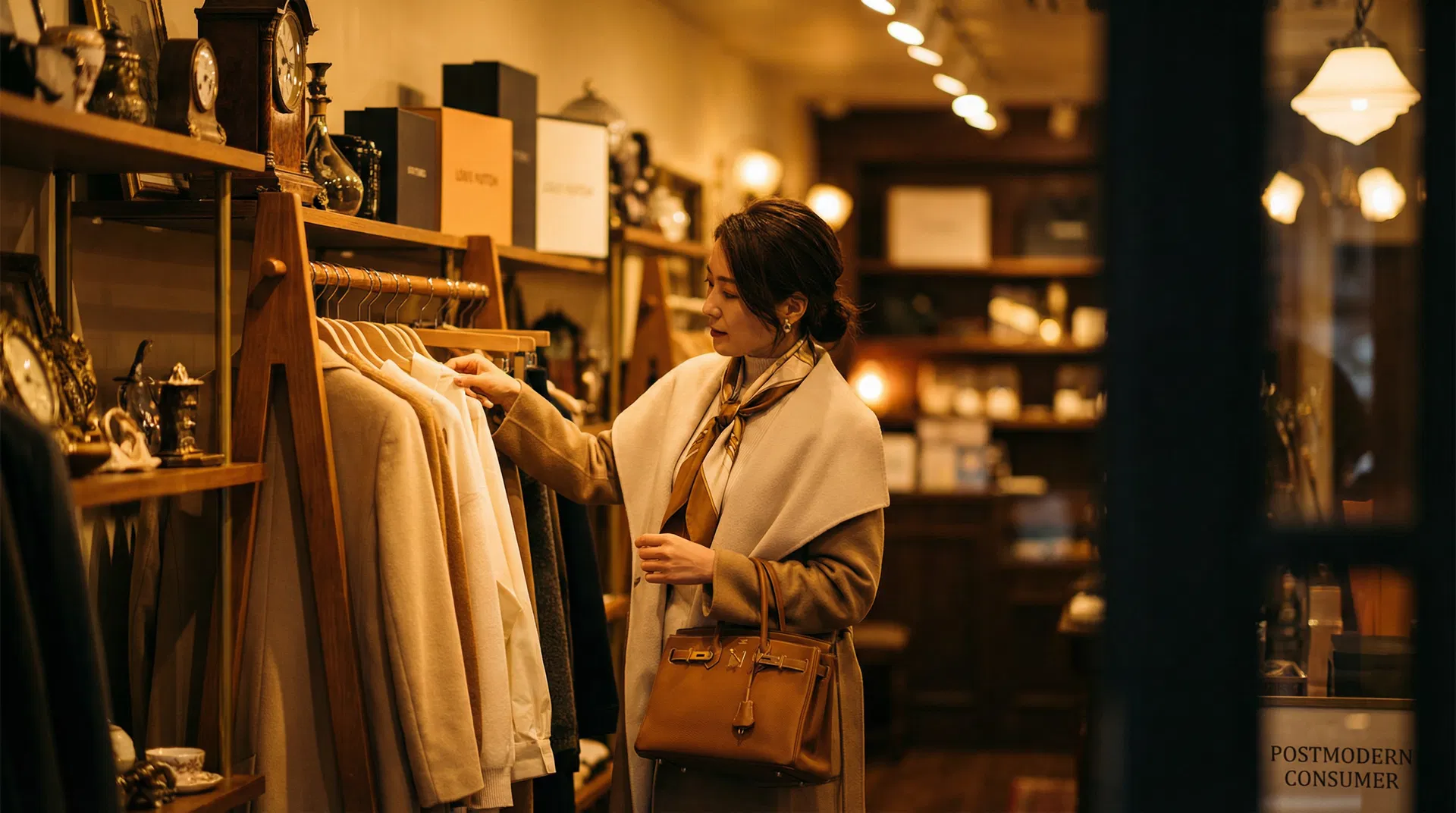
Postmodern consumption disrupts this logic in several important ways. Identity becomes fluid and self-constructed rather than inherited and stable. Consumers curate themselves from a vast palette of options, in style, in value systems, in the communities they belong to. A single consumer might shop at a luxury boutique in the morning and a vintage market in the afternoon, not out of inconsistency but out of a coherent, complex sense of self.
Authenticity becomes the highest value. Not the performance of authenticity, the rough-hewn logo, the artisanal backstory, but the genuine article: products and spaces that feel real, specific, and earned rather than manufactured and generic.
And experience displaces ownership as the primary mode of consumption. The postmodern consumer is less interested in having things than in doing, feeling, and belonging. This is the cultural context in which the experience economy was born, and it is the context in which ephemeral retail makes perfect sense.
Why the Standard Store Format Struggles
The standard retail format, a permanent store with consistent merchandising, uniform staff protocols, and a layout optimised for throughput, was designed for the modern consumer. It scales beautifully. It creates predictability. It is operationally efficient.
But it creates a specific kind of encounter: impersonal, replicable, and fundamentally transactional. Walk into one branch of most chain retailers and you could be in any other branch of the same chain, in any city, on any day. This consistency, once a virtue, has become a liability.
For the postmodern consumer, this kind of encounter offers nothing that a well-designed e-commerce platform cannot offer more conveniently. If the store is purely about transaction, finding the product, checking the price, paying and leaving, then the phone wins. Every time.
The critical insight: A physical store only justifies itself, in the postmodern context, by offering something that cannot be replicated digitally. Not product information. Not pricing. Not availability. Experience. Encounter. Meaning.
The brands that are thriving in physical retail today have understood this. They are not competing with e-commerce on convenience, they are offering something categorically different. A reason to be there in person that has nothing to do with the mechanics of purchase.
The Four Things Postmodern Consumers Seek in Physical Spaces
Through my research and field observation, I have identified four consistent desires that shape what postmodern consumers expect when they choose to visit a physical retail space. These are not universal, consumer segments vary, and so do categories. But they recur often enough, and consistently enough, to be treated as design principles.
1. Singularity
The postmodern consumer is acutely sensitive to the generic. They want to encounter something they could not have found anywhere else, a space with a specific point of view, a product they cannot easily replicate online, a visual world that reflects a genuine aesthetic sensibility rather than a trend report. Singularity is why independent bookshops survive while chains close. It is why concept stores outperform category retailers in brand metrics. It is why a well-curated pop-up in an unexpected location generates more genuine excitement than a flagship on the high street.
2. Participation
Contemporary consumers do not want to be passive recipients of a brand's message. They want to be involved, in the making, the choosing, the co-creation. Retail spaces that offer participation, whether through personalisation, hands-on product interaction, workshops, or simply the chance to be seen engaging with a brand they believe in, satisfy a deep need for agency. The customer who builds their own product, or attends a brand event, or contributes to a community moment, does not simply buy. They invest.
3. Belonging
One of the most consistent findings in consumer research is that people do not merely want products, they want to belong to something larger than themselves. Brands that create genuine community around their physical spaces, through events, through staffing that reflects their community, through a spatial language that signals 'this place is for people like you', tap into one of the deepest human motivations. This is why the most powerful retail activations feel less like shopping and more like attending something.
4. Narrative
Postmodern consumers are sophisticated readers of brand stories. They are not fooled by surface-level storytelling, the mission statement on the wall, the founder anecdote on the packaging. But they respond deeply to environments that have been constructed with genuine narrative intention. A space that takes them on a journey. A layout that unfolds with logic and surprise. A visual world that rewards close attention. Narrative in retail is not decoration, it is the primary medium through which meaning is communicated.
"Postmodern retail is not about selling products to consumers. It is about creating conditions in which consumers choose to belong to something."
Why Pop-Up Stores Are So Well-Suited to This Moment
If you read the four desires above and think 'a permanent store can deliver all of this,' you are right, in principle. Some do. But the structural pressures on permanent retail, operational consistency, cost management, scalability, staff turnover, work against the singularity, participation, belonging, and narrative that postmodern consumers seek.
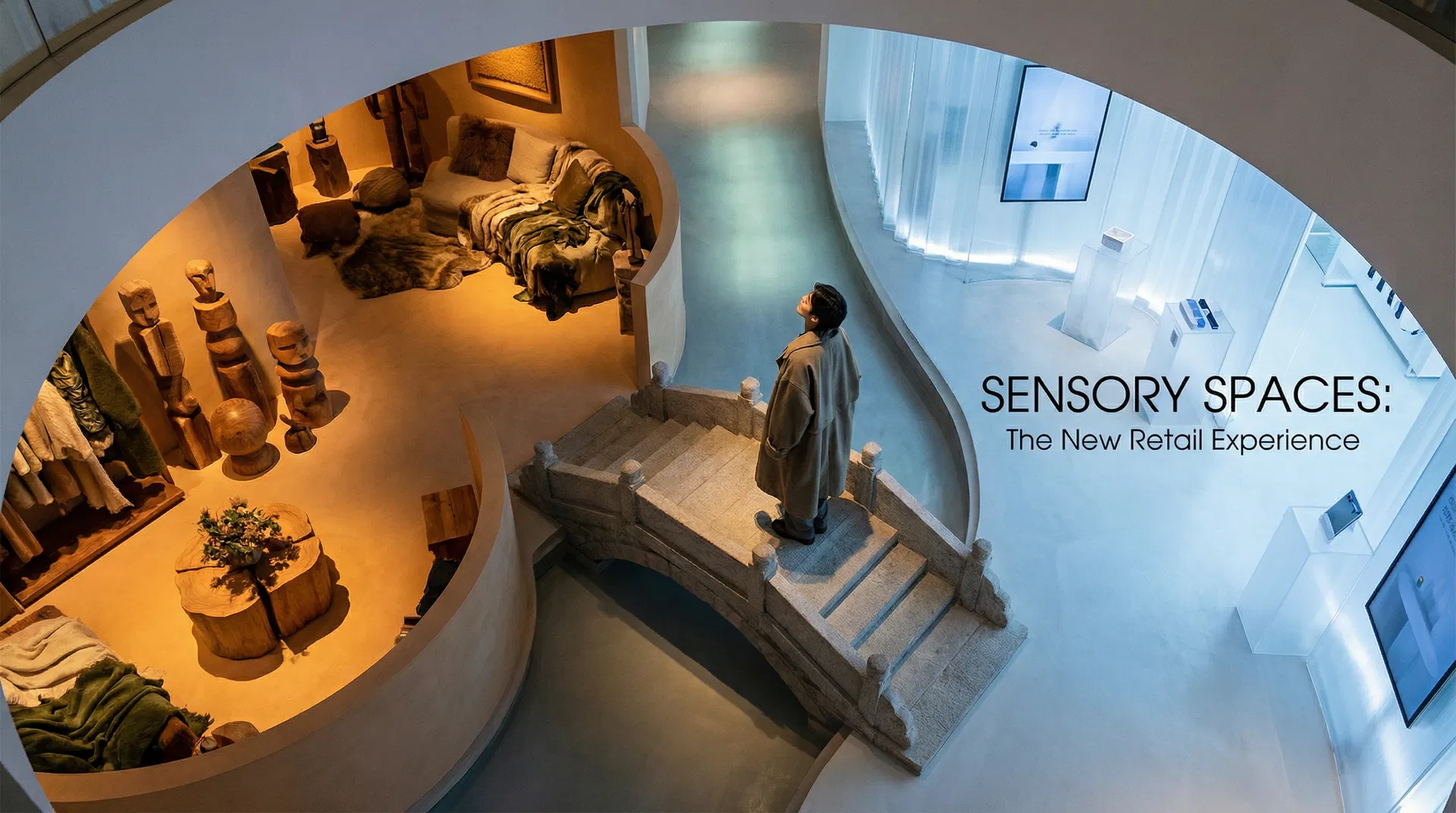
The pop-up store, by contrast, is freed from most of these constraints. Because it is temporary, it can be singular: built around a specific idea, for a specific moment, for a specific audience. Because it is bounded in time and space, it creates natural conditions for participation and belonging, you are part of something that not everyone will experience. And because it exists outside the normal retail calendar, it can be given over entirely to narrative, with no concession to the compromises of permanence.
This is why, in my doctoral research and subsequent books, I argued that the pop-up store is not simply a tactical format, it is a structural response to the conditions of postmodern consumption. It is retail designed for the way people actually are, rather than for the average of what they once were assumed to be.
What This Means for Retailers and Brand Managers
The practical implication is this: if you are designing a physical retail experience, permanent or temporary, the starting point is not the product range or the floor plan. It is the consumer's identity and the meaning they are seeking.
What does your target consumer believe in? What community do they want to belong to? What story do they want to be able to tell about themselves by choosing your brand? What could you offer them in a physical space that would make them feel not just like a customer, but like an insider, a participant, a protagonist?
These are uncomfortable questions for brands that were built on transaction logic. But they are the right questions. And the brands that answer them honestly, and then design physical spaces around those answers, will find that consumers do not simply shop there. They return. They bring others. They advocate.
The postmodern consumer is not hard to please. They are differently organised. Once you understand the logic of their desires, the design challenges of physical retail become much clearer, and much more interesting.
In your experience, as a retailer, a brand manager, or a consumer, what has a physical store done recently that made you feel something genuinely different? I am always collecting examples of retail that gets this right.
— CONTINUE THE CONVERSATION
Want deeper insights like this?
Ask Ghalia's Brain — 20 years of retail expertise, available 24/7 on WhatsApp. Start for free.
ASK GHALIA'S BRAIN