Pop-Up Retail in Luxury Brand Strategy — Published in Marketing Review St.Gallen

Ghalia Boustani
PhD · Retail Expert & Author
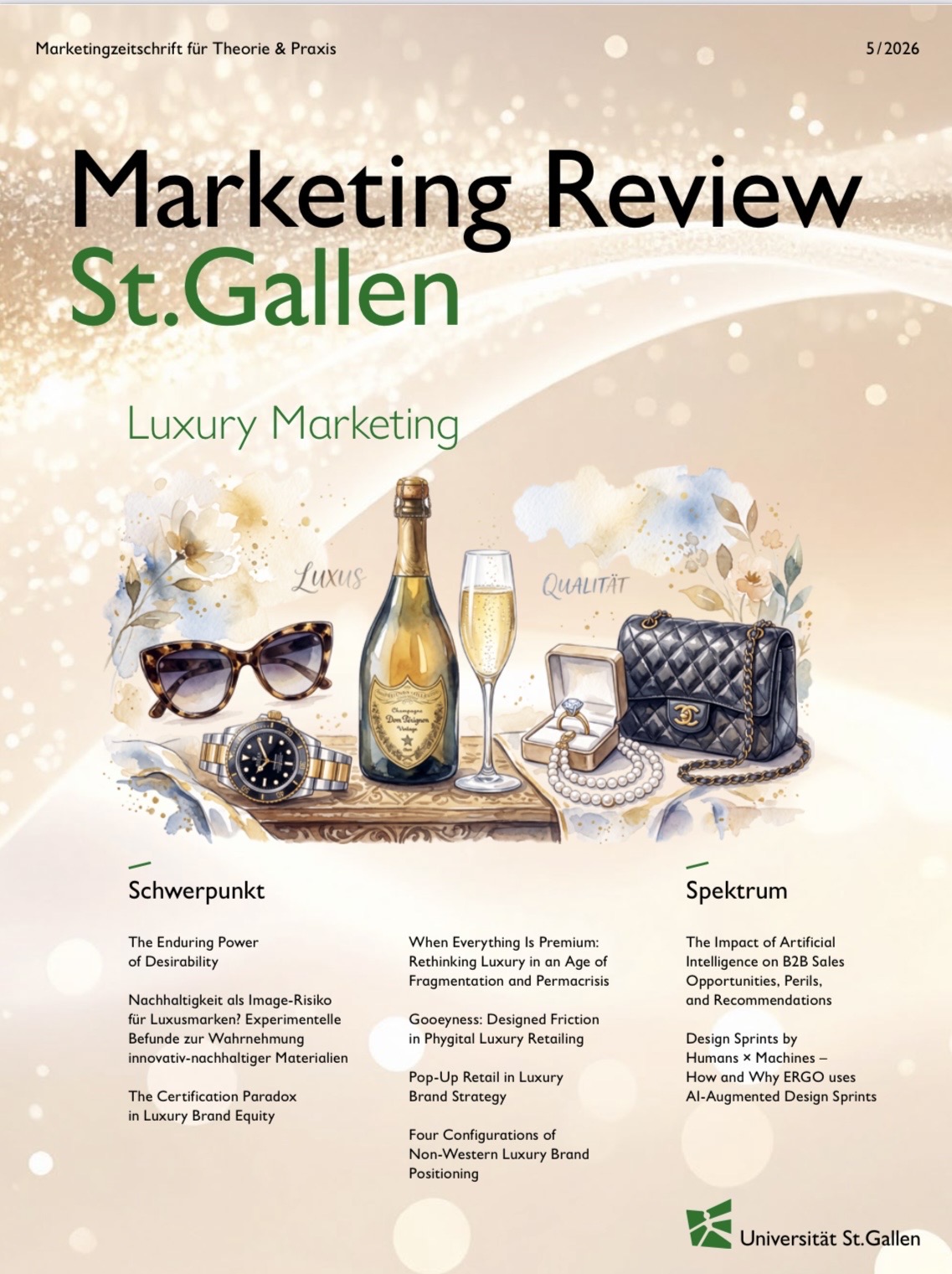
My article "Pop-Up Retail in Luxury Brand Strategy" has been published in Marketing Review St.Gallen (issue 5/2026, Luxury Marketing), the marketing journal of the University of St.Gallen. It appears in the Schwerpunkt section on Luxury Retailing, and it distils a question I have been working on for years into a framework practitioners can actually use.
"Luxury brands spend decades building stores designed to last forever, and then open pop-up stores that disappear in a weekend. This is not a contradiction; it is strategy."
That tension, permanence as aspiration and ephemerality as tool, is the starting point of the article. The flagship says: "You will always find us here." The pop-up says: "Be here now, before it is gone." Both statements are true, and both serve as complementary channels within a single omnichannel strategy.
From the Consumer Lens to the Brand Lens
Most research on pop-up retail documents what pop-ups do for consumers: brand experience, word of mouth, emotional response. Those findings are important, but they leave the more strategic question unasked: what does the pop-up do for the brand? The existing literature asks, "What does a pop-up do for the consumer?" This article asks, "What does a pop-up do for the brand?" These are different questions, and they produce different answers.
The Ephemeral Brand Environment Framework
The answer proposed in the article is the Ephemeral Brand Environment (EBE) Framework: four brand-side functions that permanent retail cannot replicate.
01 · Brand narration. Immersive storytelling beyond the permanent store, building brand mythology and emotional resonance. Think Hermès Wanderland.
02 · Community activation. Cultivating brand tribes through shared experience, generating belonging, social visibility, and advocacy. Think Chanel Coco Beach.
03 · Market intelligence. Real-time testing of product, concept, and geography, producing consumer data and purchase signals. Think Dior's pop-ups in emerging markets.
04 · Format experimentation. Piloting new retail architectures and service models, signalling brand modernity and design leadership. Think Louis Vuitton's nomadic formats.
The pop-up store does not compete with stationary retail; it operates as a complementary extension of it. Within an omnichannel architecture, permanent stores, digital channels, and temporary activations play distinct and mutually reinforcing roles.
What Practitioners Should Take From It
Four lessons close the article. Before designing a pop-up, define which of the four EBE functions it primarily serves: strategic clarity precedes spatial coherence. Treat the pop-up as one channel among several, designed to feed and be fed by physical and digital touchpoints. Set success criteria in advance for each dimension and capture both qualitative and quantitative data, turning every activation into a measurable business asset. And favour modular, reusable concepts, to lower the cost of experimentation and embed sustainability into ephemeral retail.
"Pop-up retail is no longer a novel tactic. It has become a strategic instrument for luxury brands."
Read the Full Article
The full article is available here: Download the PDF
Citation: Boustani, G. (2026). Pop-Up Retail in Luxury Brand Strategy. Marketing Review St.Gallen, 5/2026, pp. 40–46.
— CONTINUE THE CONVERSATION
Want deeper insights like this?
Ask Ghalia's Brain — 20 years of retail expertise, available 24/7 on WhatsApp. Start for free.
ASK GHALIA'S BRAIN