How Fashion Brands Can Use Pop-Ups to Test Markets Without the Risk

Ghalia Boustani
PhD · Retail Expert & Author
Expanding into a new market has always been one of the most consequential, and costly, decisions a fashion brand can make. The pop-up store changes that equation entirely. Here is how to use it as your most intelligent market intelligence tool.
Fashion brands have always expanded through a combination of ambition and intuition. A founder visits a city and feels the energy. A sales agent reports growing interest. A competitor opens a store and suddenly the question becomes: should we be there too?
These are not bad reasons to consider a new market. But they are not sufficient ones. The decision to open a permanent retail presence in a new city or country is a commitment of capital, operational capacity, and brand attention that takes years to unwind if it turns out to be wrong. And it is wrong more often than the industry likes to admit.
The pop-up store offers a fundamentally different approach: one that treats market entry not as a leap of faith but as a structured process of learning, testing, and validation. Used correctly, it transforms one of the highest-risk decisions in retail into one of the most evidence-based ones.
"Permanent retail is a conclusion. A pop-up is a hypothesis. The wisest brands know the difference."
Why Fashion Is Particularly Well-Suited to This Approach
Fashion occupies a distinctive position in retail. More than almost any other category, it is tied to identity, culture, and local sensibility. What sells in Paris may not sell in Dubai. What resonates with consumers in London may feel alien in Istanbul. A brand that has built its reputation on a specific aesthetic and customer relationship in its home market cannot assume that the same proposition will land identically elsewhere.
This cultural specificity makes market research particularly complex in fashion. Surveys and focus groups give you what people say they want. Pop-up stores give you what they actually do, how they move through a space, which products they touch and try, what questions they ask, how much they are willing to spend, and how they talk about the brand to each other in real time.
It also makes the stakes of a permanent retail commitment particularly high. A fashion store is not just a distribution point, it is a brand statement. The wrong location, the wrong fit-out, the wrong product mix for a specific market can damage brand perception in ways that take years to repair. The pop-up, precisely because it is temporary and explicitly experimental, carries none of that weight. It signals curiosity and confidence, not overreach.
What a Market-Testing Pop-Up Is Actually Measuring
This distinction matters enormously: a pop-up designed to test a market is measuring something different from a pop-up designed to generate sales or build brand awareness. Before opening, the brand needs to be clear about what intelligence it is trying to gather, because the design of the activation, from location to duration to product selection to staffing brief, should be constructed around the questions it needs answered.
The most valuable data points in a market-testing pop-up typically fall into four categories.
Customer profile validation
Who actually walks through the door? Does the visitor profile match the brand's assumptions about its target consumer in this market? Age, aesthetic sensibility, spending behaviour, language, cultural reference points, these are things you can observe and measure in a physical space in ways that digital analytics simply cannot match.
Product-market fit
Which products generate the most attention, the most try-ons, the most purchases? Which are ignored? The gap between what a brand assumes will sell in a new market and what actually moves can be startling, and invaluable. This data directly informs the buying strategy for any future permanent store, potentially saving significant inventory investment.
Price sensitivity
A brand may have a clear pricing architecture that works in its home market. A pop-up reveals whether that architecture translates. Are customers hesitating at the same price points? Are they trading up or down relative to expectations? This is particularly important for brands entering markets with different purchasing power dynamics or different competitive landscapes.
Brand perception and awareness
How much does the brand need to explain itself? Do visitors arrive with existing awareness, or is this a cold encounter? What associations do they already carry, and do those associations align with how the brand wants to be perceived? The conversations your staff have with visitors during a pop-up are among the richest brand intelligence available.
→ Before you open: Write down your five most critical market assumptions. Design the pop-up to test each of them. Review them against what you observe before you make any permanent commitment.
A Four-Stage Framework for Market Entry via Pop-Up
Based on my research into fashion brands that have used ephemeral formats to navigate market expansion, successfully and otherwise, I have identified a four-stage process that consistently produces the most reliable intelligence.
Stage 1 The Reconnaissance Pop-Up
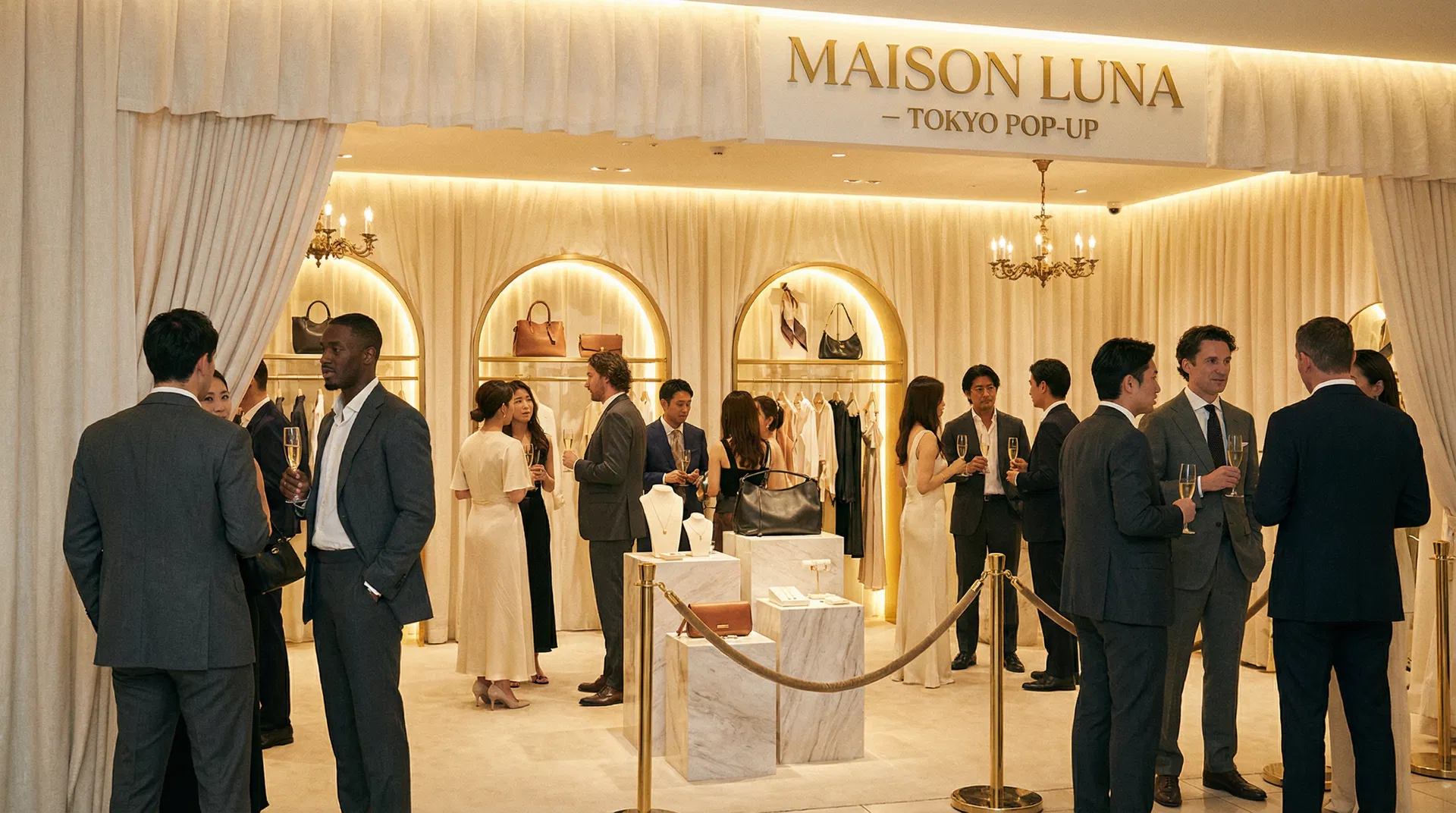
Duration: 2–4 weeks. Objective: pure observation and data gathering. This activation is designed not to maximise revenue but to maximise learning. It should be placed in a location that reflects the brand's target consumer segment, not the highest footfall location, but the most relevant one. The product selection should be broad enough to test range response but curated enough to tell a coherent brand story.
Success at this stage is not measured in sales. It is measured in the richness of the data collected: visitor profiles, product engagement patterns, staff conversation logs, social listening, and the qualitative texture of how people respond to the brand in this context.
Stage 2 The Iterative Return
Duration: 4–8 weeks, ideally in a different location or format within the same market. The brand returns with a refined hypothesis: a tighter product selection based on what the first activation revealed, a location chosen to reach a slightly different segment or neighbourhood, and a clearer brief for staff on what to observe and report.
Returning to a market signals seriousness, both to consumers, who begin to build familiarity with the brand, and to the brand itself, which starts to develop genuine local intelligence. Brands that skip this stage and proceed directly from a single pop-up to a permanent store often do so on insufficient evidence.
Stage 3 The Anchored Activation
Duration: 3–6 months. By this stage, the brand has enough market intelligence to operate with real confidence. The anchored activation, longer in duration, more permanent in feel, potentially in a fixed address, tests the operational and commercial viability of a sustained physical presence. Does the brand have the supply chain to maintain stock levels? Can it recruit and retain staff who embody the brand in this market? Does footfall sustain over months, or was the initial pop-up driven by novelty?
This stage is also where the brand builds the community and media relationships that will anchor any future permanent presence. Press, buyers, stylists, local influencers, the relationships established during a long-format activation are among its most durable outputs.
Stage 4 The Permanent Decision
Armed with eighteen months of real market data, the brand is now in a position to make the permanent retail decision from evidence rather than intuition. It knows its customer, its price points, its product mix, its operational requirements, and its brand positioning in this specific market. The permanent store, when it opens, is not a hypothesis. It is a conclusion.
Not every market journey ends in a permanent store, and that is a legitimate outcome. Some markets prove to be better served by a regular pop-up cadence than by a fixed location. Knowing this before investing in a lease is itself a significant return on the pop-up investment.
"The permanent store, when it opens, should be a conclusion , not a bet."
The Brands Getting This Right
The fashion brands that have mastered this approach tend to share a particular mindset: they are genuinely curious about their consumers, genuinely humble about the limits of their assumptions, and genuinely disciplined about treating market entry as a process rather than a moment.
Some of the most instructive examples come from luxury and premium fashion brands entering Middle Eastern and Asian markets, geographies where cultural specificity is high and the cost of misreading the consumer is significant. The brands that have built durable presences in these markets almost universally point to a period of deliberate ephemeral exploration as the foundation of their success.
The lesson is not that pop-ups are a stepping stone to permanent retail, though they often are. It is that the discipline of treating market entry as a learning process, rather than a commitment, produces better permanent retail than intuition alone ever could.
A Note on Turbulent Times
In my book co-written with Daniela Leonini, A Fashion Retailer's Guide to Thriving in Turbulent Times, we argue that the brands most capable of surviving disruption are those that have built genuine adaptability into their operating model, not as a crisis response, but as a standing capability.
The pop-up-as-market-test is one of the clearest expressions of that adaptability. A brand that knows how to enter a new market cheaply, learn quickly, and commit intelligently is a brand that is structurally better positioned for uncertainty than one that moves only when it is certain, which, in fashion, means moving rarely and often too late.
Uncertainty is not the enemy of market expansion. Ignorance is. The pop-up store is the most effective antidote to ignorance that the fashion industry has yet invented.
Has your brand used a pop-up to enter a new market, or are you considering it? What has been the hardest part of building a genuine market-testing discipline? I would love to hear what you have learned.
FURTHER READING
Explore Ghalia Boustani's Books on Retail & Pop-Up Stores
If this article raised questions you want to explore more deeply, about ephemeral retail strategy, consumer behaviour, or how fashion brands navigate turbulent markets, Ghalia's books are the most comprehensive resource available on these topics.
Ephemeral Retailing: Pop-Up Stores in a Postmodern Consumption Era
Pop-Up Retail: The Evolution, Application and Future of Ephemeral Stores
A Fashion Retailer's Guide to Thriving in Turbulent Times
Understanding Pop-Up Stores through Passion and Practice
All titles published by Routledge. Browse and order at routledge.com/search?author=Ghalia%20Boustani
— CONTINUE THE CONVERSATION
Want deeper insights like this?
Ask Ghalia's Brain — 20 years of retail expertise, available 24/7 on WhatsApp. Start for free.
ASK GHALIA'S BRAIN